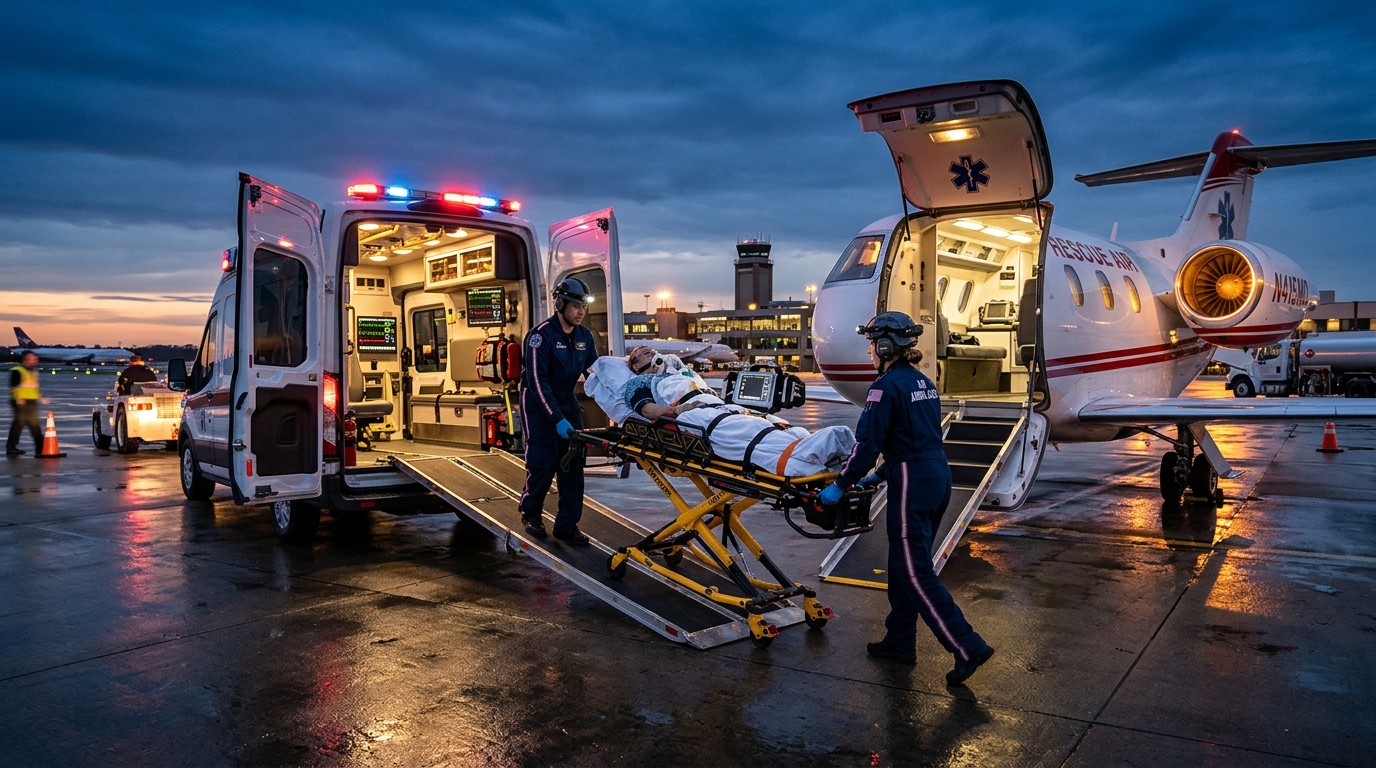
Overview of Our Advanced Life Support (ALS) Ground Ambulance
A successful air medical flight begins and ends on the ground. Our dedicated fleet of Advanced Life Support (ALS) ground ambulances ensures that the critical link between the hospital bed and the airport runway is bridged without a moment's lapse in intensive care monitoring.
At International Air Ambulance Service, we recognize that when our dispatch desk receives a call for advanced life support (als) ground ambulance, time and precision are paramount. Every flight is treated as a clinical mission under the direct oversight of our Chief Medical Officer, ensuring seamless continuity of care from bedside to bedside.
When is This Service Required?
Aeromedical transfer under this protocol is typically indicated for patients experiencing critical or specialized conditions that surpass the therapeutic capabilities of the local facility, including:
- Severe Cardiac Emergencies: Acute myocardial infarction, cardiogenic shock, post-CABG complications, or those requiring intra-aortic balloon pump (IABP) support.
- Respiratory Failure & ARDS: Patients dependent on mechanical ventilation with high PEEP or requiring extra-corporeal membrane oxygenation (ECMO).
- Neurosurgical & Neurological Crises: Traumatic brain injuries, acute ischemic/hemorrhagic stroke, intracranial hemorrhage requiring urgent decompressive craniectomy.
- Complex Polytrauma: Multi-system fractures, crush injuries, and severe burn victims requiring tertiary trauma center interventions.
- Neonatal & Pediatric Emergencies: Extreme prematurity, congenital diaphragmatic hernia, hypoxic-ischemic encephalopathy, and pediatric surgical emergencies.
- Organ Transplant Transits: Critical recipients requiring urgent cross-country travel for donor organ matches or surgical retrieval teams.
Step-by-Step Clinical & Operational Protocol
- Emergency Call & Triage: Immediate telephonic intake by our 24/7 flight coordinators, followed by clinical triage with our on-duty intensivist.
- Medical Documentation Review: Comprehensive review of the treating hospital's ICU chart, arterial blood gases, ventilator settings, and diagnostic imaging.
- Fit-to-Fly Certification: Aeromedical assessment determining optimal cruising altitude, cabin pressurization (sea-level mode if indicated), and drug infusions.
- Aviation & Runway Clearance: Aircraft flight plan filing, overflight NOTAM approvals, airport slot allocation, and direct tarmac ramp permits.
- Bedside Pickup: Advanced Life Support ground ambulance dispatched to the origin hospital with our flight medical crew to initiate bed-to-bed care.
- Airborne Intensive Care: Active stabilization, continuous hemodynamic monitoring, and medication titration at cruise altitude.
- Destination Handover: Direct tarmac arrival, priority ground transfer, and comprehensive formal bedside handover to the receiving specialist.
Equipment & Operational Specifications
| Parameter | Clinical & Technical Specification |
|---|---|
| Vehicle Type | Force Traveller / Mercedes Sprinter Mobile Intensive Care Units |
| Onboard Gear | Transport ventilator, multi-channel cardiac monitor, syringe pumps, suction |
| Airport Access | Security-cleared ramp vehicles with tarmac apron driving permits |
| Medical Continuity | Same doctor who manages the flight supervises the ground transit |
| Oxygen Autonomy | Multiple large-volume oxygen cylinders with backup regulators |
| Response Time | Pre-positioned at origin and destination airports prior to flight touchdown |
Transparent Cost Factors & Insurance Guidance
We believe in complete financial transparency during high-stress medical emergencies. The cost of advanced life support (als) ground ambulance is calculated based on direct operational variables:
- Flight Distance & Nautical Routing: Air miles between origin and destination aerodromes.
- Aircraft Category: Turboprop (e.g., King Air B200) vs. Mid-size Jet (e.g., Learjet 45XR) vs. Intercontinental Heavy Jet (e.g., Challenger 604).
- Specialized Clinical Staffing: Standard intensivist and flight nurse crew vs. specialized pediatricians, neonatologists, or ECMO perfusionists.
- Airport Tarmac Fees & Night Operations: Airstrips requiring special watch hours or lighting extensions.
- Ground Ambulance Connections: ALS ground transport coordination at origin and destination hospital points.
Our team coordinates directly with major health insurance TPAs (Third Party Administrators) and international travel insurance providers to facilitate cashless clearances whenever policy benefits cover emergency aeromedical evacuation.